




 Hugging Face
LingBot-VA
FailureOfficial teacher · exact-case rerun
ReadyOpen video ↗

APM
ANCHORED PATH MATCHING
WATCH THE OVERVIEW
Method animations, RoboTwin results, ablations, video prediction, and real-robot demonstrations. English narration and on-screen captions guide the overview.
RoboTwin footage shows a selected place_can_basket Random case with matched physical initial states (V/A = 1/1; video/action CFG = 5/1). The comparison uses a Stage I EMA4000 continued-distillation candidate and an exact-case LingBot-VA rerun; this candidate differs from the budget-matched Continued ablation. This qualitative example was selected for APM success and candidate failure, rather than to estimate aggregate success rates.
FEWER STEPS. PAIRED SUPERVISION.
Coarse denoising can move a student away from its teacher’s trajectory. Anchored Path Matching (APM) restarts the teacher at a student-reached state, pairing a completed-output target with instantaneous field matching at that same state and time. One checkpoint supports 1, 2, and 4 steps, with no teacher at deployment.
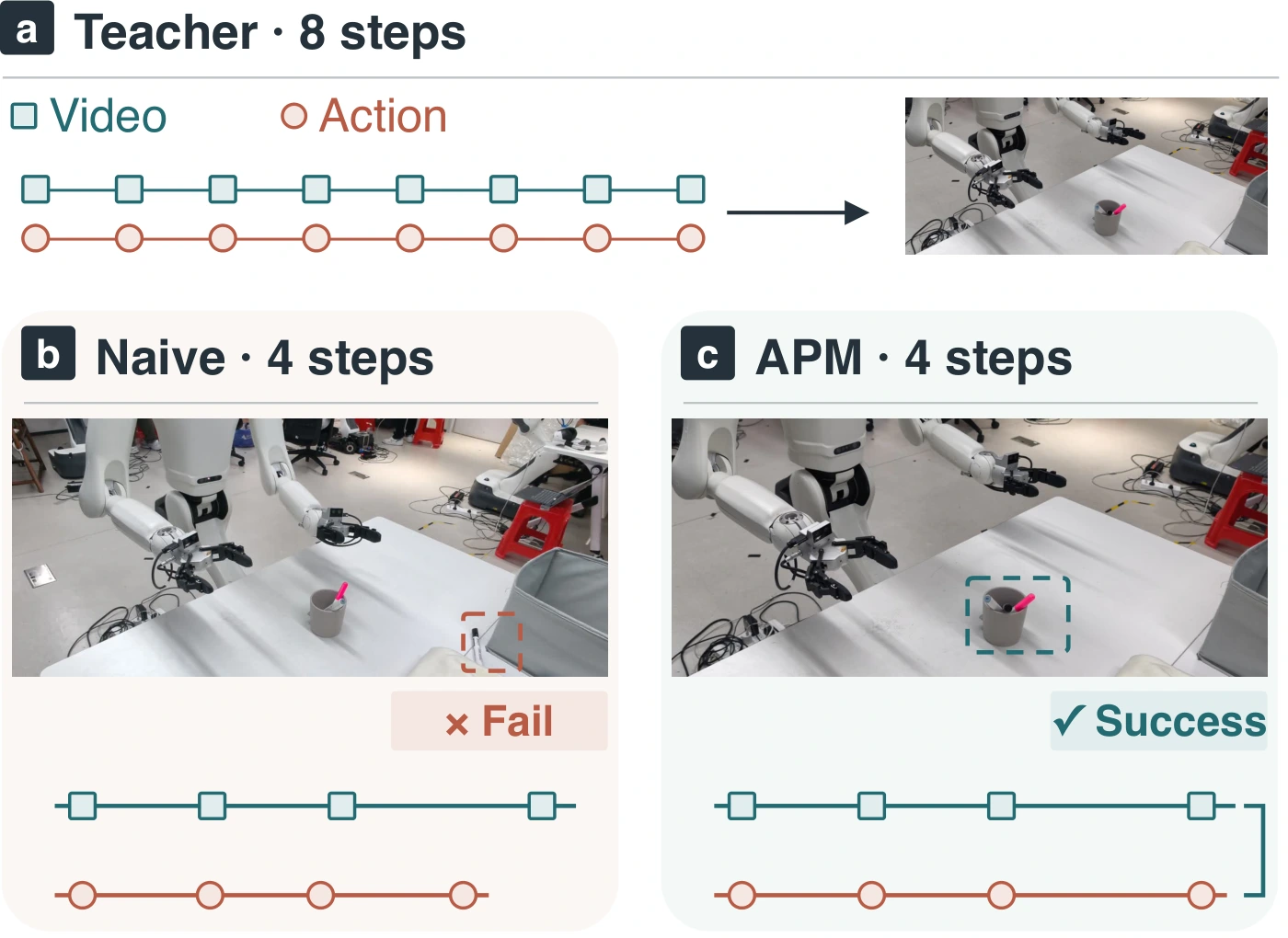
World Action Models jointly generate future video and robot actions through iterative denoising. Few-step distillation reduces the number of model evaluations, but its coarse updates can move the student away from the teacher’s trajectory. We propose Anchored Path Matching (APM), which supervises endpoint predictions and instantaneous direction fields at states reached by the student. From each state, we continue the teacher to zero noise for the restart endpoint and match the teacher and student directions at the same detached state and time. Modality-routed adapters learn both objectives from the shared starting state. When the two gradients conflict, anchor-priority updates preserve the endpoint gradient and remove the opposing component of the field gradient within each modality. One checkpoint supports 1-, 2-, and 4-step joint generation. On RoboTwin 2.0, APM improves single-step success over continued distillation by 2.0 percentage points on Clean and 1.4 points on Random. On two real-robot tasks, it improves success over the one-step teacher and reduces control-cycle latency by 21.3× relative to the eight-step teacher.
APM first learns a finite-interval video–action transition map through teacher-integrated distillation. It then freezes the base and trains modality-routed adapters to correct predictions from states encountered along the student’s own trajectories.
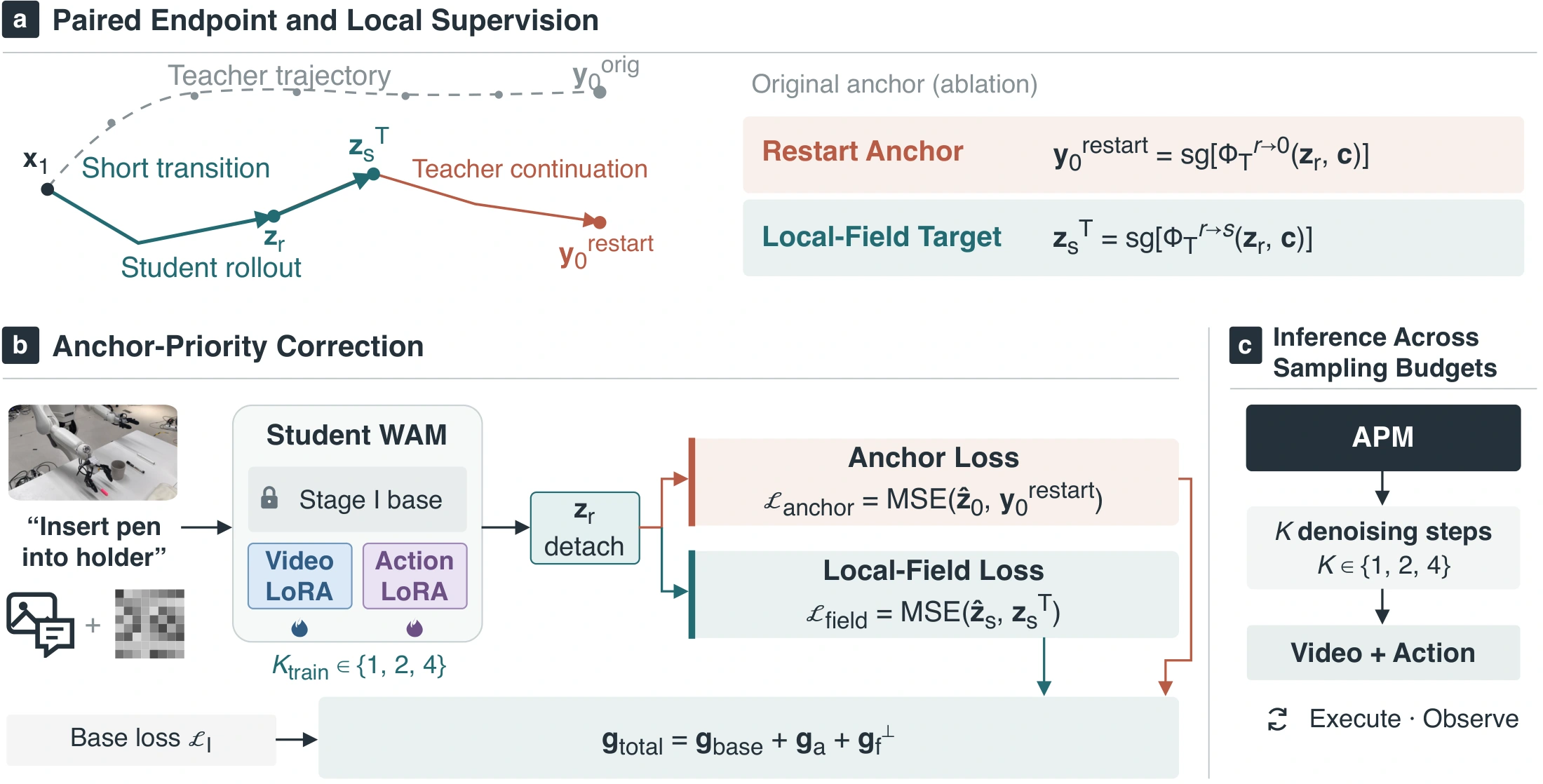
Collect a state from the student’s generation trajectory and hold it fixed for correction.
Continue the frozen teacher to zero noise for the endpoint, then match its instantaneous direction at the shared state and time.
Remove the opposing component of the local gradient when it conflicts with the endpoint gradient, within each modality.
APM is trained on Clean data only and evaluated directly on RoboTwin 2.0’s Clean and domain-randomized Random settings. Across 1-, 2-, and 4-step inference, it improves average success over continued base distillation. Select a matched video/action budget below.
| Method | Clean ↑ | Random ↑ | Average ↑ | Δ |
|---|---|---|---|---|
| LingBot-VA(1/1) | 57.0 | 50.7 | 53.9 | — |
| Flash-WAM †(1/1) | 82.1 | 74.2 | 78.2 | — |
| Continued(1/1) | 82.3 | 76.1 | 79.2 | — |
| APM(1/1) | 84.3 | 77.5 | 80.9 | +1.7 |
| LingBot-VA(2/2) | 88.3 | 86.0 | 87.2 | — |
| Flash-WAM(2/2) | 90.5 | 88.6 | 89.6 | — |
| Continued(2/2) | 89.6 | 87.7 | 88.6 | — |
| APM(2/2) | 90.4 | 87.1 | 88.8 | +0.1 |
| LingBot-VA(4/4) | 90.4 | 90.0 | 90.2 | — |
| Flash-WAM(4/4) | 92.0 | 90.4 | 91.2 | — |
| Continued(4/4) | 90.5 | 89.1 | 89.8 | — |
| APM(4/4) | 92.5 | 90.3 | 91.4 | +1.6 |
1-step APM: 80.9% average success · +1.7 percentage points over Continued.
Success rates (%). Local evaluations cover 50 tasks × 50 episodes per condition. Each student variant uses one checkpoint across all budgets. Δ is the gain over Continued, computed before rounding. † Flash-WAM’s one-step result is reported by DirectWAM; its two- and four-step results are evaluated locally. Full-budget LingBot-VA (25/50, reported): 92.9% Clean / 91.6% Random.
WATCH THE CLOSED LOOP
Explore five selected RoboTwin 2.0 episodes. All methods use one video and one action sampling step, with matched physical initial states.
Official teacher · exact-case rerun
Stage I EMA4000 candidate
step10000 EMA · native 16/32
Select a task, then play all three videos together.
Cases selected for APM success and candidate failure; aggregate results are reported above. Original 10 fps recorder playback, not physical or wall-clock time. Shorter episodes hold their final frame. Success and failure labels describe the actual videos shown.
These are all five APM-success / candidate-failure cases among 100 matched cases with complete RGB for both methods. They illustrate selected outcomes, not aggregate success rates. In the bowl and shoe cases, the LingBot-VA rerun also succeeds.
All methods: V/A = 1/1; video/action CFG = 5/1; 16 actions on the first execution, then 32; real observation feedback and head-camera RGB every 4 actions. Each group shares its task, setting, episode, seed, policy seed, fixed-case hash, and physical scene-state hash.
The Continued comparison is a Stage I EMA4000 continued-base-distillation candidate, distinct from the budget-matched Continued ablation. LingBot-VA videos are exact-case reruns; their displayed outcomes come from these reruns, not historical manifests. The older candidate's observed-image fingerprint includes renderer-dependent bytes; physical-state matching is verified using actor poses and robot joints.
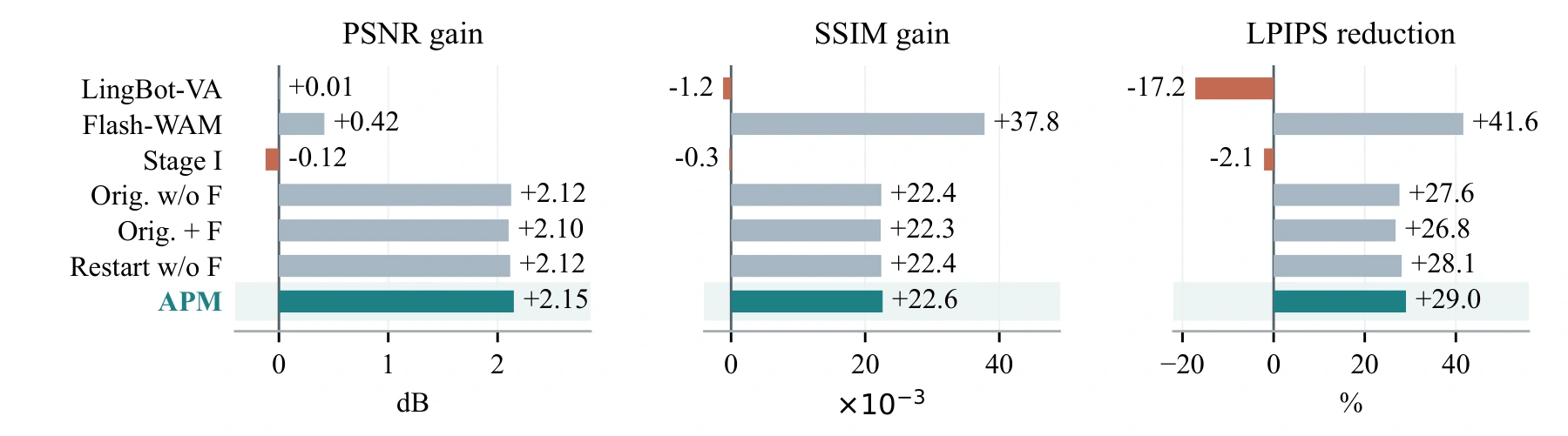
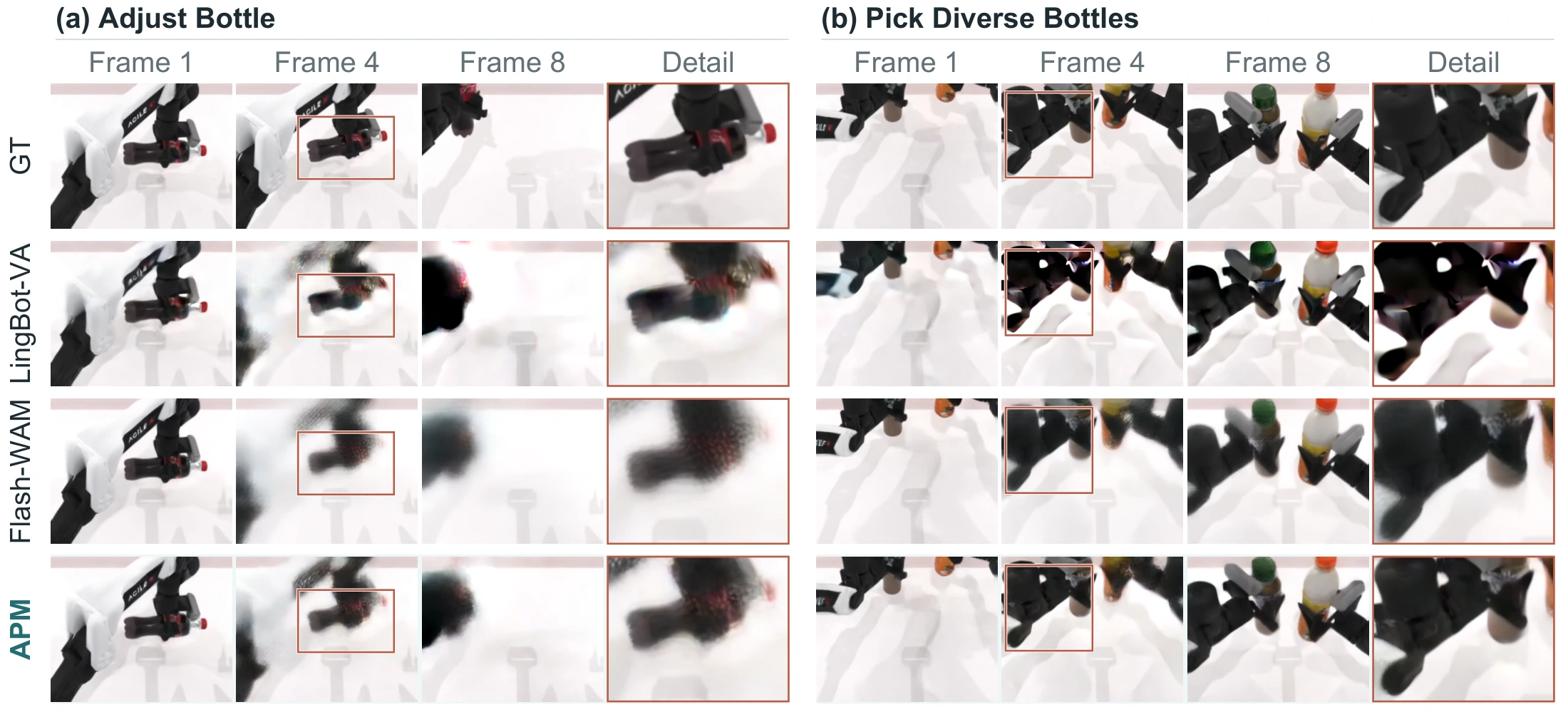
Compared with continued Stage I distillation, APM increases single-step PSNR from 30.169 to 32.317 dB, alongside improvements in SSIM and LPIPS. The evaluation uses 500 shared contexts with ground-truth observation histories. Against Flash-WAM under each model’s deployment configuration, APM has higher PSNR; Flash-WAM has better SSIM and LPIPS.
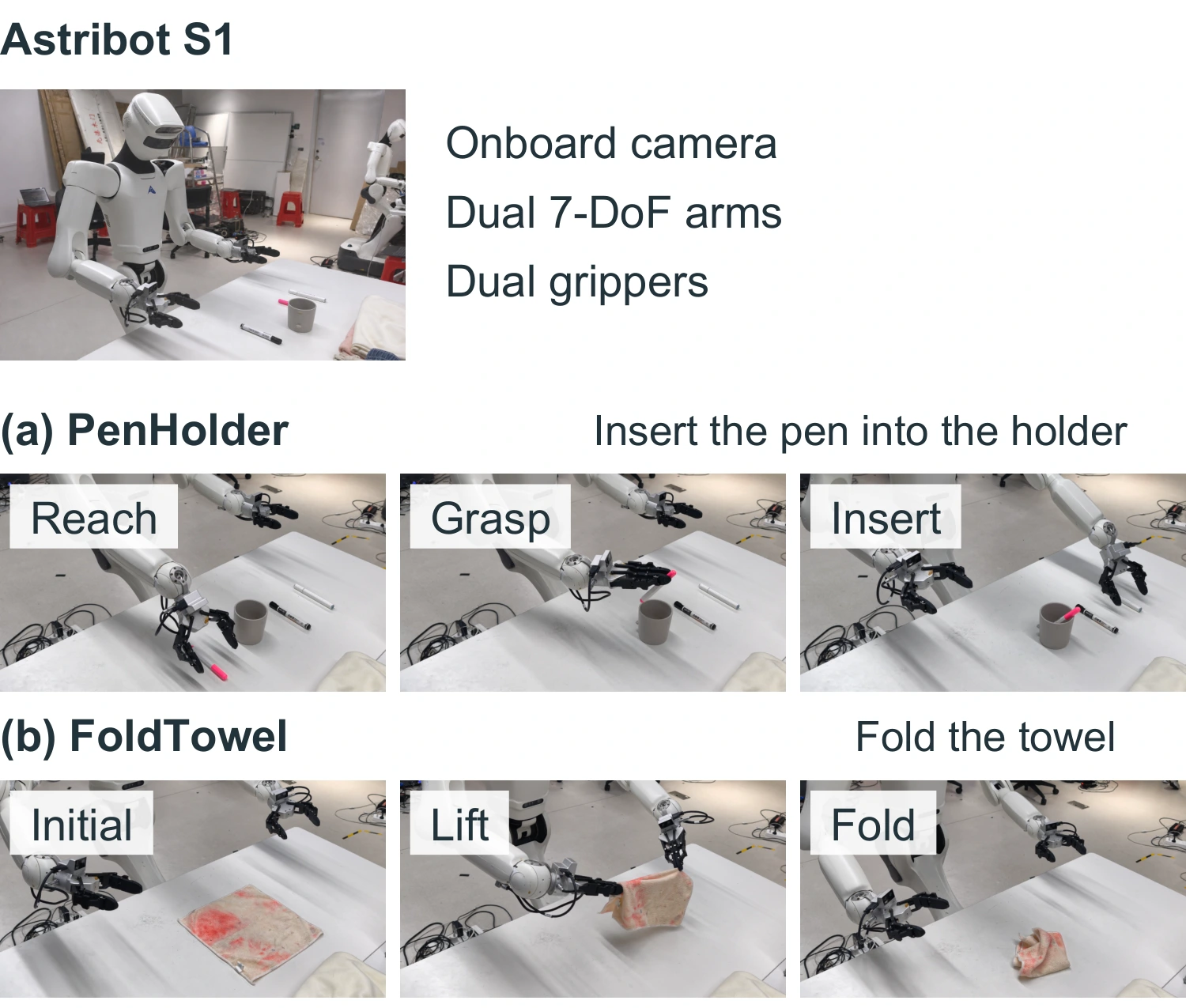
Without task-specific retraining, single-step APM improves success over the coarse-grid teacher on both tasks. Compared with the full eight-step teacher, it reduces latency from 4323.6 to 203.1 ms.
The task tradeoff remains visible: APM has lower success on PenHolder and higher success on FoldTowel than the full teacher. Inference runs on an NVIDIA A800 GPU with 80 GB of memory.
| Method (video/action steps) | PenHolder ↑ | FoldTowel ↑ | Latency ↓ |
|---|---|---|---|
| Teacher (8/8) | 83.3% | 70.8% | 4323.6 ms |
| Coarse teacher (1/1) | 29.2% | 25.0% | 187.5 ms |
| APM (1/1) | 62.5% | 75.0% | 203.1 ms |
@misc{liu2026anchoredpathmatching,
  title = {Distilling World Action Models for Efficient Bimanual Manipulation via Anchored Path Matching},
  author = {Jialong Liu and Junjie He and Yandu Chen and Bin Zhou and Heng Su and Peijun Tang and Jianan Wang and Changhao Chen},
  year = {2026},
  eprint = {2611.22592},
  archivePrefix = {arXiv},
  primaryClass = {cs.CV},
  doi = {10.48550/arXiv.2611.22592},
  url = {https://arxiv.org/abs/2611.22592}
}